
For the team’s personal development, a tool to give them the time they need.
Today, I hope to give you a quick introduction to the 70:20:10 framework for training and development, and some tips on how to implement it. I’ll try to keep it role agnostic, although perhaps my tech bias will be apparent.
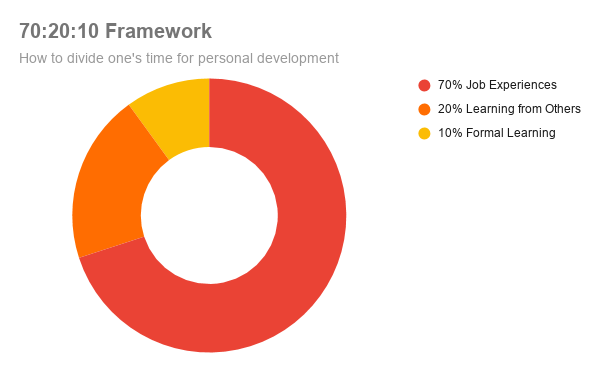
In short, the framework is used in the training/development of individuals. The framework holds that 70% of one’s time should be spent learning on the job, through experience. 20% should be spent learning from others, and 10% should be spend learning from formal sources/resources.
Why should we care about the development of our peers/employees? Employee retention is important, and personal development might be a big reason for an employee to stick with their current position; especially if it affords real growth and potential for promotion/increased responsibilities.
It’s also widely held that new employees cost a lot to be trained, I personally don’t think the training should ever stop. Always be learning as Marc Littlemore illustrates in this great blog post.
Now to the examples. This framework was devised in the 1980s, I believe it’s a fair observation that the tech industry has moved on a bit since then, and my examples come from real, 21st century workplaces or use modern learning tools/facilities.
70% On the job experience
While perhaps the most self explanatory, I’ll highlight a few useful practices to help foster personal development.
Giving your own talks can be beneficial for learning/refining skills. I’ve been lucky enough to give talks at universities and seminars, which have improved my ability to communicate information and speak in public (for dealing with fear, I’ve got you covered). If your company doesn’t offer this on work time, consider volunteering your free/holiday time.
Take on responsibilities at work, whether it’s working on challenging tasks/stories, or owning certain areas of the project, you can usually find areas of a project to pick up and do some learning. Work with your team to find the right time to do this, so as not to endanger work towards deadlines.
Work as part of a strike team for a certain feature, work on a spike test to improve your understanding, fix a pre-existing problem in your product, if you look, you should be able to find things to do to improve your skills/learn new skills.
20% Learning from others
Learning from others can take any form. I’ve been an advocate for mentoring/teaching in the workplace, and this is perhaps the most direct form of learning from others. I’d like to write more on this in the future!
As a junior, don’t be afraid to ask for help or clarification on a topic. More often than not, a senior developer would rather you do something right, but ask them questions, than to make progress in the wrong direction in a vacuum. As a senior, talk to your team in your free time, give some detailed code reviews and help/challenge the junior members where possible.
I’m a big fan of working with, and understanding, all disciplines in your studio. Learn how to talk with your artists, speak with your QA team. Give your honest opinion, and if you work directly with them, tell them what you think they do well.
Managers can give 1:1s, although these need to be effective and meaningful to contribute towards personal development.
Volunteer to help that new apprentice or intern, or maybe even start your own initiative within the company to share skills; you’ll have something to give, no matter how experienced you are.
10% Learning from formal sources
We have access to a great many resources. Ted talks, GDC talks, podcasts, perhaps your company offers internal talks given by your peers. Even a quick search on Google can uncover many informative blogs/tutorials. Oh and don’t forget to follow those authors on Twitter (I’m @TheWonderWells) and surround yourself with great discourse. I’m again going to direct you to Marc’s great post for more examples of where to learn.
We should be learning everyday, and hopefully your company supports you on that journey. As a valuable member of a team, you might have to do the majority of your learning during a quiet time, but if your workplace is anything like mine, you’ll have quieter days in which to be proactive about your learning.